

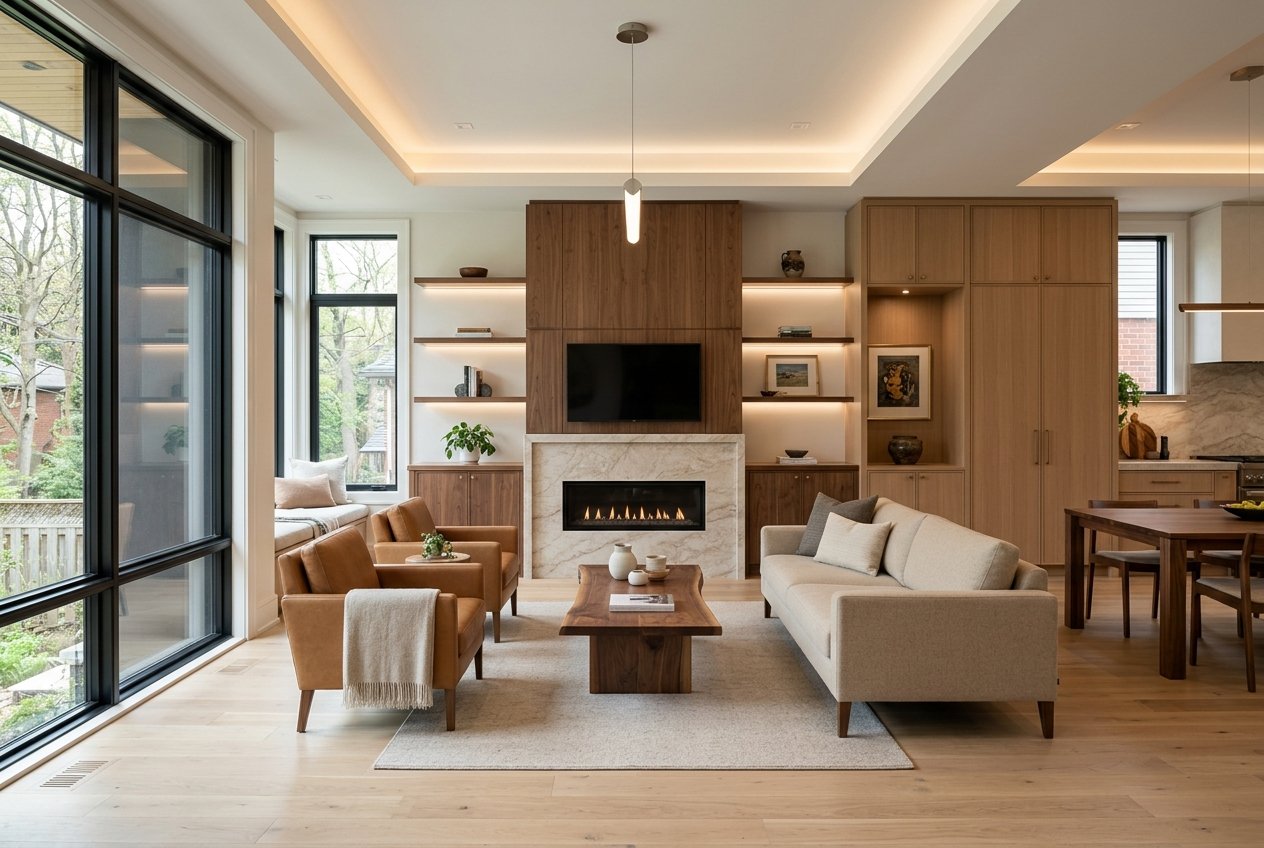
First, walk into two newly renovated homes, and you can feel the difference almost immediately.
Moreover, this contrast reflects the quality of a high end home renovation Hamilton project.
Both might have new kitchens.
Both might have new flooring, lighting, bathrooms and fresh paint.
One feels polished, intentional and genuinely high-end.
The other feels like a collection of new materials installed in the same house.
Interestingly, the difference isn’t always the price of the finishes.
An expensive counter-top can’t correct poor proportions. Premium flooring won’t hide awkward transitions. Designer fixtures won’t make poorly positioned lighting look intentional. And beautiful cabinetry can quickly lose its impact when fillers, panels, appliances and surrounding finishes don’t align properly.
Moreover, a high end home renovation Hamilton relies on much more than the products homeowners can see.
It’s created by the planning, craftsmanship and attention to detail behind them.
At Elite Building & Construction, we believe that’s an important distinction.
The goal shouldn’t simply be to install expensive materials.
The goal should be to build the entire space well enough that every material looks its best.
1. High-End Renovations Feel Intentional
One of the biggest differences between an average renovation and an exceptional one is whether the finished space feels intentional.
Nothing looks accidental.
The kitchen island feels like it belongs exactly where it is.
The lighting relates to the cabinetry and furniture below it.
Doorways line up with important sight lines.
Flooring transitions happen where they make sense.
Trim terminates cleanly.
Cabinetry fills the space properly.
The rooms feel connected rather than renovated independently.
You may not consciously notice every one of these details when you enter the home.
But you notice the result.
The space simply feels right.
That feeling usually begins long before construction.
It comes from thinking through the entire project instead of solving one detail at a time as the renovation progresses.
2. Quality Starts Before the Finishes Arrive
Homeowners understandably spend a lot of time choosing visible finishes.
Cabinet colours.
counter-tops.
Tile.
Flooring.
Faucets.
Light fixtures.
Those selections matter.
But by the time many of those products arrive on site, some of the decisions that determine the quality of the finished renovation have already been made.
Walls need to be properly framed.
Floors may need to be levelled.
Openings need to be correctly sized.
Plumbing needs to emerge where fixtures actually belong.
Electrical boxes need to correspond with cabinetry, mirrors and appliances.
Ceiling details need to account for lighting, HVAC and structural requirements.
A renovation is built in layers.
If the early layers aren’t right, the finishing trades eventually have to compensate for them.
That’s why quality construction isn’t something that gets added at the end.
It has to be built into the project from the beginning.
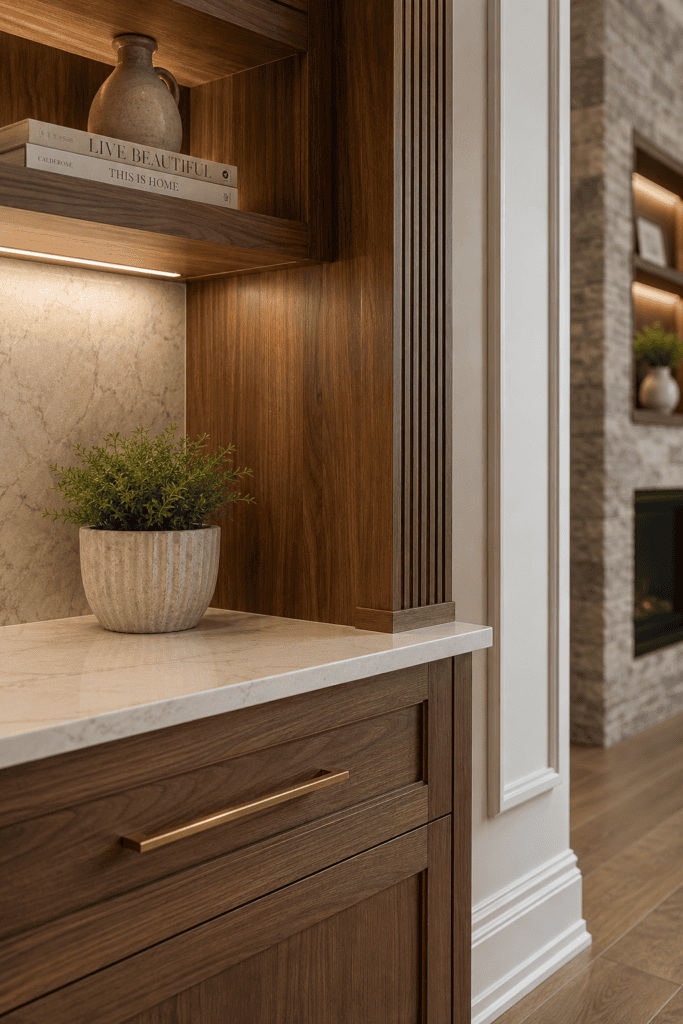
3. Straight, Level and Square Matter More Than People Think
These sound like basic construction principles.
They are.
They’re also incredibly important.
A slightly uneven wall may not attract much attention during framing.
Then cabinetry is installed against it.
A counter-top follows.
A back-splash highlights the difference.
Upper cabinets make the variation more obvious.
Suddenly a small framing issue has become a visible finishing problem.
The same applies throughout a renovation.
Floors affect cabinetry.
Framing affects drywall.
Drywall affects trim.
Rough plumbing affects fixtures.
Rough electrical affects lighting.
Every trade inherits the work that came before it.
High-quality renovation work recognizes those relationships.
Getting the fundamentals right makes everything installed afterwards look better.
4. Good sight lines Make a Home Feel More Refined
sight lines are one of those design details homeowners may experience without necessarily identifying.
Stand at the front entrance and look through the home.
What do you see?
Now stand at the kitchen island.
Look toward the living room.
Walk down the hallway.
Look through an open doorway.
Good renovations consider those views.
A beautifully framed opening can draw your eye toward a fireplace, kitchen, window or architectural feature.
Poorly considered layouts might instead direct your attention toward the side of a refrigerator, an awkward wall termination or a misplaced doorway.
This becomes especially important when walls are removed to create open-concept spaces.
Opening the home isn’t simply about creating the largest possible opening.
It’s about creating better relationships between the spaces on either side.
When structure, layout and finishes work together, the home feels considered rather than simply opened up.
5. Consistency Makes a Renovation Feel More Expensive
A renovation doesn’t need dozens of statement materials to feel custom.
In fact, too many competing ideas can sometimes have the opposite effect.
High-quality homes often have a strong sense of consistency.
The same metal finish might appear subtly throughout the main floor.
Door hardware relates to plumbing fixtures.
Wood tones complement one another.
Trim details repeat from room to room.
Lighting has a consistent colour temperature.
Flooring flows naturally through connected spaces.
Cabinetry details feel related even when they’re located in different rooms.
None of these choices need to be particularly expensive on their own.
What matters is that they appear to belong together.
Cohesion often creates more visual impact than constantly upgrading individual materials.
6. Lighting Can Elevate — or Undermine — the Entire Renovation
Lighting is one of the clearest examples of why installation and planning matter as much as the fixture itself.
A beautiful pendant light can still look wrong if it isn’t centred properly over the island.
Recessed lights can make a ceiling feel chaotic if they’re positioned without considering cabinetry, beams, furniture or architectural features.
Under-cabinet lighting can dramatically improve a kitchen when it’s properly integrated.
Bathroom lighting can completely change how tile, mirrors and finishes appear.
Even the colour temperature of the bulbs affects the finished space.
Good lighting design usually includes layers:
- General lighting
- Task lighting
- Accent lighting
- Decorative fixtures
- Natural light
The fixture is only one part of the equation.
Where the light is placed and what it’s intended to illuminate matter just as much.
7. Cabinetry Reveals Attention to Detail
Cabinetry occupies a huge amount of visual space in kitchens, bathrooms, mudrooms, laundry rooms and built-ins.
That makes it one of the easiest places to see the difference between simply installing something and integrating it into the architecture.
Look at the details.
How does the cabinetry meet the ceiling?
How does it terminate against the wall?
Are fillers balanced?
Do panels conceal unfinished appliance sides?
Are handles aligned?
Does the island relate properly to the room?
Do upper cabinets line up with surrounding elements?
Are outlets incorporated thoughtfully?
Does crown moulding terminate cleanly?
Individually, these can seem like very small decisions.
Together, they determine whether cabinetry feels like furniture placed into a room or something designed specifically for the home.
8. Transitions Are Where Quality Often Shows
Every renovation has transitions.
Tile meets hardwood.
New flooring meets existing flooring.
Drywall meets cabinetry.
Baseboard meets a door casing.
A counter-top meets a back-splash.
An addition connects to the original house.
New construction meets something that was already there.
These junctions aren’t usually the glamorous parts of a renovation.
They’re also where craftsmanship becomes very visible.
A beautiful material with a poor transition can immediately look cheaper.
A modest material with a clean, carefully considered transition can look exceptional.
This is one of the reasons attention to detail matters so much.
The quality of a renovation often reveals itself at the places where two different things have to meet.
9. Trim and Millwork Quietly Shape the Entire Home
Baseboards, casing, interior doors, crown moulding and custom millwork may not receive the same attention as a new kitchen counter-top.
But they create the framework around almost everything else.
Well-executed trim gives rooms clean edges and consistent proportions.
Poorly executed trim creates gaps, awkward joints and visual distractions that can make an otherwise expensive renovation feel unfinished.
The same is true of interior doors.
Door style, height, hardware and casing all contribute to the character of a home.
Sometimes improving these architectural details has more impact than upgrading a single expensive finish.
They’re not necessarily the first things someone notices.
They’re part of why the entire home feels finished.
10. Expensive Materials Cannot Fix Poor Workmanship
This is perhaps the most important point.
There is a limit to what materials can do.
A premium tile still needs to be laid out properly.
Expensive hardwood still needs a properly prepared substrate.
High-end cabinetry still needs accurate installation.
A luxury faucet still needs properly located plumbing.
Designer lighting still needs thoughtful placement.
Stone counter-tops still depend on properly installed cabinets beneath them.
Homeowners sometimes concentrate heavily on product selections because they’re tangible and easy to compare.
But the quality of the finished renovation depends heavily on who installs those products and how the entire project is coordinated.
A $200 tile installed exceptionally well can look better than a $20-per-square-foot tile installed poorly.
Quality craftsmanship allows the materials to do what they were intended to do.
11. Details Become More Important as the Design Gets Simpler
Modern interiors can appear simple.
Clean cabinetry.
Large-format tile.
Minimal trim.
Flush transitions.
Continuous surfaces.
But simple-looking designs can actually demand greater precision.
When there are fewer decorative elements, there’s less to disguise inconsistencies.
A clean drywall return needs to actually be clean.
Large tile emphasizes alignment.
Minimal cabinetry makes spacing more obvious.
Long sight lines expose walls that aren’t straight.
Flush details require careful planning between trades.
The simpler the finished design looks, the more important the construction behind it can become.
That’s why minimal doesn’t necessarily mean easy.
12. Good Project Coordination Shows in the Finished Product
Renovations involve many different trades and suppliers.
Framers.
Electricians.
Plumbers.
HVAC technicians.
Drywall installers.
Tile setters.
Flooring installers.
Cabinetmakers.
Painters.
Trim carpenters.
counter-top installers.
Each one may complete a different part of the project, but the homeowner ultimately sees one finished renovation.
Good project management connects those pieces.
For example, the electrician needs to understand the cabinetry layout before placing certain outlets.
The plumber needs accurate fixture information before rough-in.
The tile installer needs to understand the shower glass and niche locations.
The cabinet installer needs to coordinate with counter-tops and appliances.
When those conversations happen early, details tend to look intentional.
When they don’t, compromises often become visible in the finished work.
13. Quality Is Often Found in What You Don’t Notice
Some of the best construction details aren’t designed to attract attention.
You shouldn’t notice that the kitchen island is perfectly positioned.
It should simply feel comfortable to walk around.
You shouldn’t notice that the outlets were carefully located.
They should simply be where you need them without distracting from the design.
You shouldn’t notice how the flooring transition was handled.
It should simply look natural.
You shouldn’t think about why the lighting feels balanced.
The room should simply feel good.
That’s one of the interesting things about quality construction.
When it’s done well, many of the decisions disappear into the finished space.
You notice the home — not the problems.
14. Where Should Homeowners Spend Their Renovation Budget?
This doesn’t mean finishes don’t matter.
They absolutely do.
But when deciding where to invest, homeowners should consider the entire renovation rather than directing too much of the budget toward a few visible products.
A balanced renovation budget needs to account for:
- Proper planning
- Structural work where required
- Skilled trades
- Electrical, plumbing and HVAC
- Proper preparation
- Quality installation
- Project coordination
- Durable materials
- Finishing details
There’s little benefit in purchasing the most expensive finishes available if compromises have to be made everywhere else to afford them.
Sometimes a more moderately priced material installed exceptionally well produces the better finished home.
Elite Insight: Quality Isn’t One Upgrade — It’s Hundreds of Small Decisions
There usually isn’t one feature you can point to and say:
That’s what makes this renovation high-end.
It’s rarely just the counter-top.
Or the flooring.
Or the cabinetry.
It’s the accumulation of decisions made throughout the project.
The wall that was straightened before the cabinets arrived.
The outlet that was moved so it wouldn’t interfere with the back-splash.
The ceiling light that was centred on the island instead of simply placed where it was easiest.
The flooring transition that was planned before demolition.
The trim detail that continues properly into the next room.
The mechanical system that was relocated instead of boxed awkwardly into the finished space.
Individually, these decisions can seem small.
Together, they’re what separate a renovation that simply looks new from one that feels professionally built.
At Elite Building & Construction, that’s where we want our work to compete:
Not simply on the price of the materials being installed, but on the quality of the construction, coordination and attention to detail behind them.
Frequently Asked Questions
Do I need expensive finishes to make my renovation look high-end?
No. Premium materials can certainly enhance a renovation, but proportion, layout, lighting, consistency, craftsmanship and installation quality often have an equally important effect on the finished result.
Where is workmanship most noticeable in a renovation?
Cabinet installation, tile layout, flooring transitions, trim, drywall finishing, paint preparation and the alignment of fixtures are some obvious areas. However, quality work during framing and rough-ins also affects everything installed afterwards.
Is it worth fixing uneven walls and floors during a renovation?
Depending on the severity and scope of the project, correcting existing conditions can make a significant difference. Cabinets, tile, flooring, doors and trim all depend on the surfaces they’re installed against. Older Hamilton homes in particular may require additional preparation before new finishes are installed.
Should I choose finishes before construction begins?
Major selections should generally be made early enough to coordinate rough-ins, dimensions, lead times and installation requirements. Waiting until late in construction can limit options or create unnecessary changes.
What should I look for when comparing renovation contractors?
Look beyond the final price. Consider the scope of work, what’s included and excluded, how the project will be managed, communication, trade coordination, previous work, insurance and how details are handled during planning.
A High-End Renovation Is Built — Not Bought
Beautiful materials matter.
But materials alone don’t create a beautiful renovation.
The difference is often found in everything surrounding them:
The preparation.
The alignment.
The installation.
The transitions.
The coordination.
The finishing.
And the hundreds of decisions made before the homeowner ever sees the completed room.
That’s why comparing renovations based solely on the price of cabinets, flooring, tile or fixtures doesn’t tell the whole story.
Quality construction makes good materials look better. Poor construction can make expensive materials look ordinary.
At Elite Building & Construction, our focus is on creating renovations where the workmanship behind the finishes receives the same attention as the finishes themselves.
Because when the details are handled properly, you don’t just see the difference.
You feel it every time you walk into the room.
Related Services
If you’re planning a renovation where workmanship and attention to detail matter, these Elite Building & Construction services may help:
Full Home Renovations in Hamilton
Coordinate multiple rooms, trades and finishes as one cohesive renovation rather than a collection of separate projects.
Kitchen Renovations in Hamilton
Create a kitchen where cabinetry, lighting, electrical, plumbing, flooring and finishes are planned to work together.
Bathroom Renovations in Hamilton
Build bathrooms around proper waterproofing, tile installation, plumbing, lighting and carefully executed finishing details.
Create new square footage that feels like a natural extension of the existing home through careful structural, architectural and finishing coordination.
Modify existing layouts while properly addressing the structural work required behind the finished design.
Basement Renovations in Hamilton
Turn unfinished or outdated lower levels into comfortable spaces that feel connected to the quality of the rest of the home.
Talk with our team about your renovation plans and the level of finish you’re hoping to achieve.
Helpful Resources
Homeowners planning renovations can also explore these resources:
City of Hamilton — Building Permits
Information about building permits and renovation requirements in Hamilton.
Provincial information about the standards governing construction and renovation work in Ontario.
Canada Mortgage and Housing Corporation
Homeowner information covering renovation, housing and home improvement considerations.

No responses yet