

Your home design for all 4 seasons in canada shouldn’t only feel incredible on a beautiful summer afternoon. In Canada, it should work just as well on a cold February night.
Last Monday, in Part 1 of The Psychology of Home, we explored a simple idea:
The way your home is designed can influence daily life, including home design for all 4 seasons in canada.
A thoughtful renovation can make routines easier, encourage people to spend more time together, reduce everyday frustrations, and ultimately help you enjoy your home more.
But we ended Part 1 with another question.
What about where you live?
Because designing a home in Ontario isn’t the same as designing one somewhere that experiences essentially the same climate throughout the year.
We have hot summer afternoons.
Cold winter nights.
Long summer evenings.
Short winter days.
Rain.
Snow.
Humidity.
And those changes don’t simply affect the exterior of our homes.
They change how we experience the spaces inside them.
That’s where Part 2 begins.
Your Home Has Two Very Different Personalities
Picture your home on a Saturday afternoon in July.
The doors are open.
Sunlight fills the kitchen.
Someone is outside cooking.
People move between the kitchen, patio, deck, and backyard.
The house feels connected to everything around it.
Now picture that same home on a February evening.
It’s dark outside before dinner.
The doors and windows are closed.
Everyone has moved indoors.
Suddenly, lighting, warmth, comfort, acoustics, and the places where people naturally gather become much more important.
Same house. Completely different experience.
That’s one of the most interesting challenges of designing a home in Canada.
We don’t need our homes to do one thing exceptionally well.
We need them to do two almost opposite things exceptionally well.

1. Summer Should Pull You Outside
After spending much of the year waiting for warmer weather, Canadians tend to make the most of summer.
And your home’s design can either encourage that—or make it surprisingly difficult.
Think about the journey from your kitchen to your backyard.
If you’re carrying food outside, how many doors do you pass through?
Can you see the patio from the kitchen?
Can someone cooking inside still feel connected to everyone outside?
Does opening the rear of the house make the indoor and outdoor spaces feel like one larger entertaining area?
These are architectural decisions, but they influence behaviour.
A thoughtfully positioned patio door or larger rear opening can change how frequently a family uses its backyard.
A kitchen overlooking the deck can make outdoor dining feel natural rather than inconvenient.
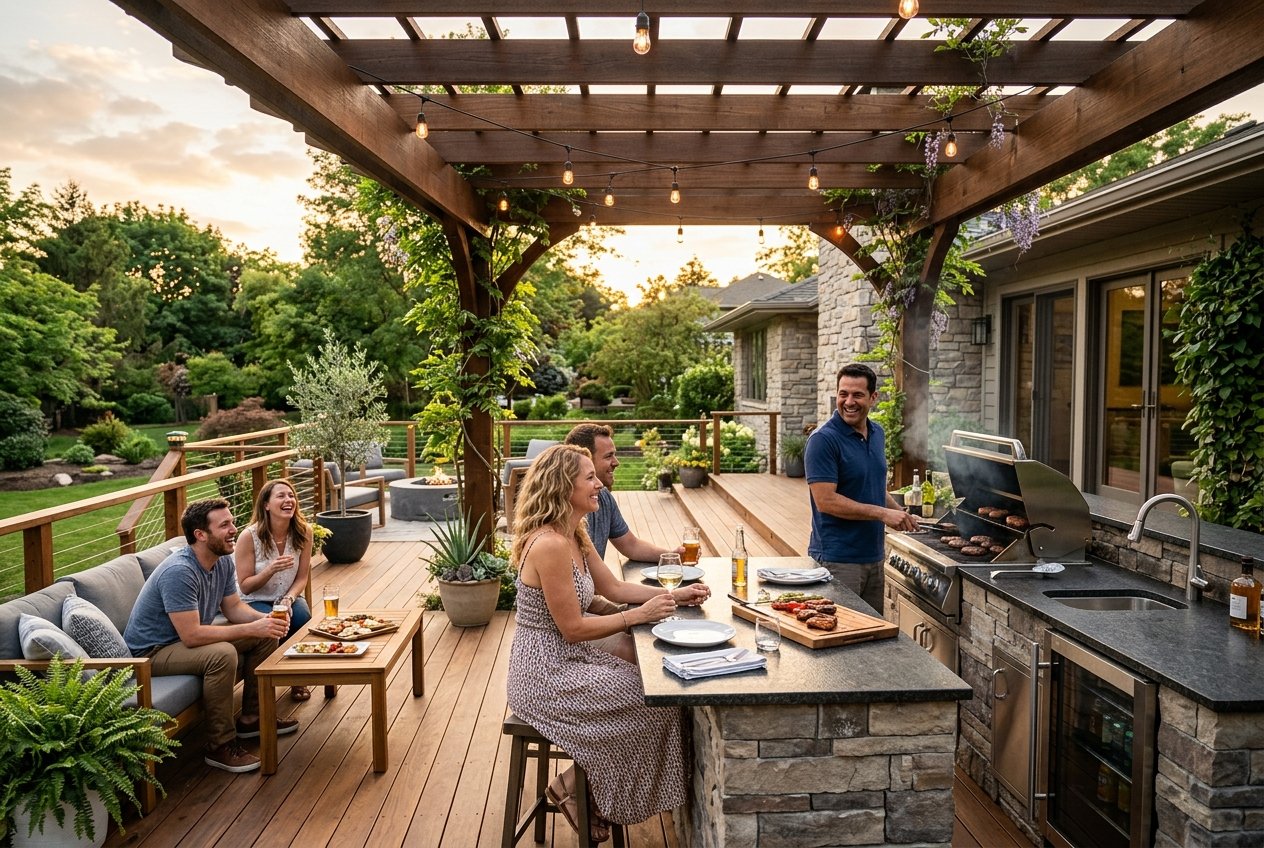
A covered patio can make going outside appealing even when the weather isn’t perfect.
Great summer design removes the barriers between your home and everything outside it.
2. Winter Should Pull You Back In
Then the relationship reverses.
During winter, the goal isn’t necessarily to connect you physically with the outdoors.
It’s to make being indoors feel so comfortable that you don’t mind staying there.
This is where the emotional atmosphere of a home becomes incredibly important.
Warm layered lighting.
A fireplace.
Comfortable seating.
Natural textures.
A kitchen that invites people to gather.
A basement that becomes somewhere the family actually wants to spend time.
A bathroom with heated floors on a cold morning.
None of these features is important simply because it looks good.
They change the experience of winter inside your home.
The house becomes more than shelter from the weather.
It becomes somewhere you genuinely want to be.
3. The Best Spaces Transform
This may be the biggest difference between designing for a Canadian climate and designing purely for appearance.
A great room shouldn’t have only one identity.
Imagine a kitchen and living area with large rear doors.
In summer, those doors open and the room expands onto the deck.
The kitchen becomes part of an indoor-outdoor entertaining space.
In winter, those same doors frame the snow outside while the interior becomes warm, enclosed, and intimate.
Nothing physically moved.
But the experience of the room completely changed.
That’s seasonal design at its best.
You’re not building separate summer and winter homes.
You’re designing spaces capable of becoming both.
4. Design the View, Not Just the Window
Windows are usually discussed in terms of natural light.
We covered the importance of daylight in Part 1.
But there’s another reason windows matter.
They frame your surroundings.
A backyard filled with trees.
A garden.
A mature neighbourhood.
A ravine.
A rural property.
Even snowfall can become part of the interior experience when the architecture responds to it.
This is where location becomes important.
A renovation shouldn’t automatically use the same window arrangement simply because it looked beautiful in another house.
Ask:
What’s worth looking at on this property?
Then consider whether the home’s layout actually takes advantage of it.
Sometimes the most valuable feature you can bring into a room is something that’s already outside.
5. Ontario’s “In-Between” Seasons Matter Too
Summer and winter get most of the attention.
But some of Ontario’s best days happen between them.
Spring mornings.
Cool September evenings.
October afternoons.
These are the days when flexible spaces become especially valuable.
A covered deck can remain comfortable when there’s light rain.
Retractable or large patio doors can open when temperatures are mild.
Covered entrances make arriving home easier when the weather changes.
Outdoor lighting can make patios inviting even after the earlier sunsets of fall begin.
Instead of thinking about outdoor living as something that lasts only from June through August, good design can help stretch the usable season in both directions.
And in Canada, those extra weeks matter.
6. Covered Outdoor Living Changes the Equation
One of the most effective ways to extend outdoor living is simply to provide protection from the elements.
A covered deck or patio can create shade during hot afternoons.
It can provide shelter during summer rain.
It can make cool evenings more comfortable.
And it creates a visual transition between the interior of the house and the backyard.
This is especially effective when the covered space connects directly to a kitchen or main living area.
Instead of having:
House → Door → Backyard
you begin to create:
Interior → Covered Living Space → Backyard
That middle zone can completely change how connected the house feels to the property.
7. Think About the Sun at Different Times of Year
Here’s something that’s easy to overlook during renovation planning:
The sun doesn’t interact with your house the same way throughout the year.
Its position changes.
The length of daylight changes.
Trees may provide shade in summer and lose their leaves in winter.
A room that feels bright and comfortable in August can feel dramatically different in December.
This doesn’t mean every renovation needs to become an architectural study of the sun.
But when you’re making major changes—especially additions, large windows, rear openings, or new living spaces—it’s worth considering how those spaces will feel at different times of day and different times of year.
You’re not designing for the day construction finishes.
You’re designing for thousands of days afterwards.
8. Comfort You Can’t See Still Matters
Some of the most important aspects of a four-season home aren’t visible in the finished photographs.
Insulation.
Air sealing.
Efficient windows and doors.
Heating and cooling.
Ventilation.
Moisture management.
These features aren’t usually what homeowners save to an inspiration board.
But they directly affect whether that beautiful new space actually feels comfortable.
A gorgeous addition that becomes excessively hot in summer or difficult to keep warm in winter isn’t truly well designed.
The finishes create the appearance of the room.
The building behind those finishes helps create the experience of it.
That’s an important distinction when renovating in Ontario.
9. Location Should Influence the Renovation
Part 1 focused primarily on how your family lives.
Part 2 adds another layer:
Where does your family live?
A home on a mature Hamilton street may have completely different opportunities than a rural property outside the city.
A property with a deep backyard may benefit from stronger rear-facing connections.
A home surrounded by mature trees may have natural shade worth preserving.
A property with beautiful views may justify changing the orientation of a living area.
An urban home with neighbouring houses nearby may require a more thoughtful approach to privacy.
There isn’t one universal layout that works everywhere.
The best renovation responds to the people, the house, and the property together.
10. Create a Home You Don’t Need to Escape From
There’s a subtle idea behind this entire two-part series.
Many people think about their dream lifestyle as something that happens somewhere else.
The cottage.
The resort.
The patio at a restaurant.
The hotel bathroom.
The weekend getaway.
But what if some of the qualities you love about those places could become part of your everyday environment?
A relaxing ensuite.
A covered backyard retreat.
A kitchen designed for long dinners.
A fireplace where everyone gathers during winter.
A bright room overlooking the garden.
You don’t need to turn your house into a resort.
The point is much simpler:
Your home should contain places you genuinely look forward to spending time in.
Summer or winter.
Monday morning or Saturday night.
The Perfect Canadian Home Isn’t a Summer Home or a Winter Home
It’s both.
It opens up when the weather is beautiful.
It becomes intimate when temperatures fall.
It connects you with your surroundings without sacrificing comfort.
It gives you reasons to go outside and reasons to enjoy staying in.
And perhaps most importantly, it responds to the reality that life in Canada changes dramatically throughout the year.
That’s why seasonal thinking shouldn’t be an afterthought.
It should be part of the design.
From Part 1 to Part 2: What Makes a Home Feel Right?
At the beginning of Part 1, we talked about walking into certain homes and immediately feeling that something is right—even when it’s difficult to explain why.
Across these two articles, we’ve explored some of the reasons.
It’s the way a home supports your routines.
The way spaces bring people together.
The way the layout responds to your lifestyle.
And, as we’ve explored here, the way the home responds to the world outside it.
Good design isn’t one feature.
It’s the relationship between hundreds of decisions that ultimately determine how a home feels to live in.
The Elite Building & Construction Approach
At Elite Building & Construction, we believe a successful renovation should respond to more than a list of finishes.
It should consider the existing house.
The property.
The people living there.
The way they use their home.
And how those needs change throughout the year.
Whether that means opening a kitchen toward the backyard, creating a covered outdoor living space, improving an existing layout, finishing previously unused space, or building an addition, the objective is the same:
Create a home that works beautifully for the life being lived inside it.
Not for one photograph.
Not for one season.
For everyday life.
Final Thoughts: Fall in Love With Your Home Again
That’s ultimately what this two-part series has been about.
Not renovating simply because something is old.
Not chasing every new design trend.
And not creating a home purely for resale.
It’s about recognizing how much of your life happens within the walls of your home—and designing those spaces accordingly.
In summer, your home should help you enjoy the outdoors.
In winter, it should make you appreciate being inside.
In spring and fall, it should adapt somewhere between the two.
And throughout all four seasons, it should feel unmistakably yours.
Because the best home isn’t necessarily somewhere else.
Sometimes it’s the home you already have—thoughtfully reimagined around the way you actually want to live.
Frequently Asked Questions
Why should Canadian seasons be considered when planning a renovation?
Ontario homes experience major changes in temperature, daylight, humidity, precipitation, and how homeowners use their spaces. Considering those changes during design can help create a home that’s comfortable and functional throughout the year.
How can I make indoor and outdoor spaces feel more connected?
Door placement, larger openings, sightlines, covered patios or decks, and locating interior entertaining areas near outdoor spaces can create a more natural connection between the house and backyard.
Can a covered deck extend Ontario’s outdoor season?
Yes. Protection from direct sun and rain can make an outdoor space useful in a wider range of conditions and potentially extend how often homeowners enjoy it during spring and fall.
Should my property’s location affect my renovation design?
Yes. Views, privacy, orientation, neighbouring properties, mature trees, backyard size, and other site conditions can all influence decisions about windows, doors, additions, decks, and room layouts.
What should I consider when adding large windows or patio doors?
Beyond appearance, consider orientation, views, energy performance, privacy, summer heat, winter comfort, and how the opening connects interior rooms with outdoor areas.
Should energy efficiency be considered during a major renovation?
Yes. When walls, windows, roofs, or mechanical systems are being altered, the renovation can provide opportunities to consider insulation, air sealing, windows, heating, cooling, ventilation, and overall comfort.
Related Services
If this series has you thinking differently about your own home, explore the Elite Building & Construction services that can help transform it:
Full Home Renovations
Explore Full Home Renovations
Home Additions
Explore Home Additions
Kitchen Renovations
Explore Kitchen Renovations
Basement Renovations
Explore Basement Renovations
Structural Renovations
Explore Structural Services
Ready to rethink the way your home works?
Book Your Free Quote
Helpful Resources
Natural Resources Canada — Energy Efficiency for Homes
Information for Canadian homeowners about energy efficiency, insulation, windows, heating, cooling and home improvements.
Natural Resources Canada — Homes
Ontario Building Code
Information about Ontario’s building requirements for construction and renovation projects.
Ontario Building Code Information
City of Hamilton — Building Permits
Local information for homeowners planning renovation, addition and construction projects in Hamilton.
City of Hamilton Building Permits

No responses yet